



step forward and Contribute to a National R&D agenda for High School Transformation
Tell us about the work you’re leading to advance the priorities outlined in the Carnegie R&D Agenda for High School Transformation.
Submissions due by 11:59 pm PST anywhere in the world on April 30, 2026.

The Carnegie Foundation for the Advancement of Teaching (Carnegie Foundation) is seeking input from researchers who share our commitment to transforming American high schools so that every student has the opportunity to live a healthy, dignified and fulfilling life. This Request for Information (RFI) aims to identify individuals, teams and organizations already engaged in—or interested in contributing to—work aligned with our Research and Development (R&D) Agenda for High School Transformation.
This RFI serves three purposes:
- To learn what work is already underway related to our essential foundations and priorities;
- To identify potential collaborators—researchers interested in working with us toward a new educational architecture; and
- To understand important gaps, barriers and opportunities that should inform our high school transformation strategy.
American high schools stand at a critical juncture. While the world accelerates toward an AI-driven economy demanding creativity, critical thinking and adaptability, our high schools remain trapped in an outdated architecture designed for a different era. The evidence is stark: Employers seek skills not reflected in diplomas; four-year college enrollment is dropping; and since the pandemic, chronic absenteeism has soared, student disengagement has accelerated, and educator burnout has reached crisis levels.
This is not a moment for incremental change—it is a moment for transformation.
In collaboration with partners nationwide, the Carnegie Foundation is committed to building a new architecture for the American high school—one grounded in ambitious goals for student learning, new learning experiences rooted in the science of learning, and signaling systems that provide actionable insights and clear pathways to postsecondary education and work. To achieve this vision, we have developed a comprehensive R&D Agenda that identifies critical areas requiring coordinated research, development and implementation efforts. We invite you to respond to this RFI if you are interested in supporting us in advancing this agenda and helping to shape the future of American high school education.
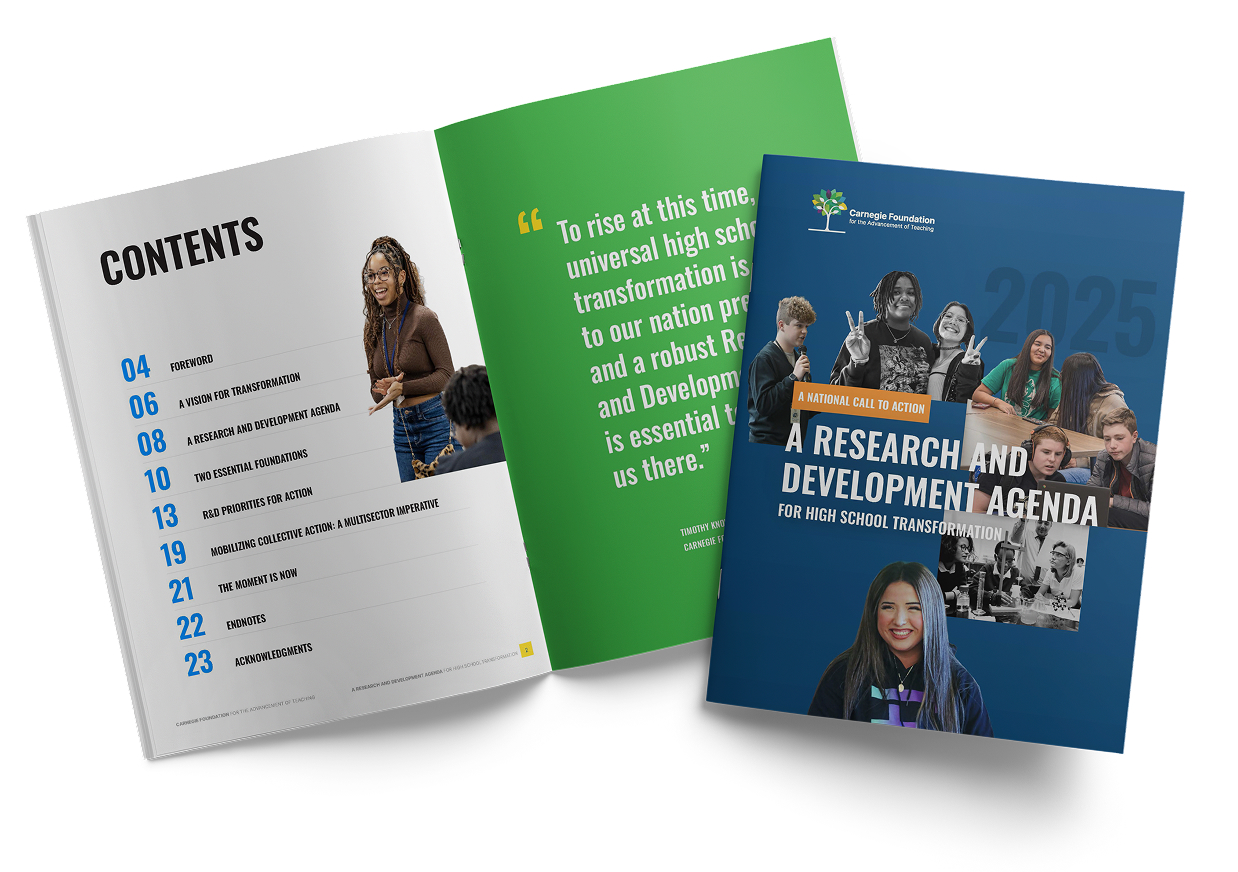
A National Call to Action
Carnegie’s national Research and Development Agenda (R&D Agenda) is aimed at supporting the transformation of the American high school from time-based to competency-based models, to better prepare students for civil society and the modern economy.
Watch the RFI Informational Webinar
In case you missed it, we hosted an informational webinar to walk through our Request for Information: Research and Development for High School Transformation and answer any questions you might have had.
Watch the recording here using passcode: c8qtF?Hr

This RFI is for information and strategic planning purposes only. It is not an application for funding, a solicitation for proposals or an offer to contract, and responses alone will not result in funding decisions.
That said, the Carnegie Foundation for the Advancement of Teaching (the “Foundation,” thereafter) expects to use what it learns to inform future work and anticipates developing invitation-only Requests for Proposals (RFPs). Responses to the RFI may guide whom the Foundation engages or invites.
For this RFI, “researcher” is meant broadly. Individuals, teams and organizations are welcome. This includes (but is not limited to) education researchers and learning scientists, policy researchers/analysts, experts in assessment/measurement/evaluation, implementation/improvement researchers, and researchers in AI, learning technologies and educational data science. If your work involves generating, testing, evaluating or translating research evidence to inform transformative changes in high school systems and outcomes, your work is likely relevant.
Section 1 is mandatory for all respondents. If you are short on time, prioritize Sections 2 and 3, focusing on the questions that are most relevant to your expertise, work and context. Some prompts may not apply, and it is fine to avoid repeating information. For example, if you address three priorities in Section 3 and explain how they are interconnected while answering 3.3 (Connection to Other Areas) under your first priority, you do not need to restate the same connections under each additional priority.
We welcome evidence at different stages of development. For early-stage work, “evidence of promise” may include preliminary findings, feasibility or usability evidence, a well-supported theory of change, evidence from initial implementation, prior research that motivates the approach, early indicators of uptake and/or a credible evaluation design currently in progress.
The Foundation may share submissions with internal staff and a limited set of trusted reviewers (e.g., advisors, consultants, independent subject matter experts and potential co-funders) for purposes of review and synthesis. Reviewers will be asked to maintain confidentiality of specific submissions. The Foundation will share aggregated themes and learnings publicly, but will not publicly share identifiable information from individual submissions without their permission.
The Foundation will not publicly identify individual respondents or attribute specific ideas to individuals without their explicit permission. We respect respondents’ intellectual property and do not seek to claim ownership of your underlying research, methods or materials. If the Foundation wishes to explore a specific research question or concept originating from your submission, it will consult with you first.
Yes. International researchers are eligible to respond when the work is focused on and conducted in U.S. high schools. Please clearly note the geographic context of your work (where it takes place and what settings it is designed to inform).
You may attach up to three documents (such as publications, project descriptions or case studies). Please keep each attachment under 10 MB total. If a supplementary resource is hosted online, you may include and describe the link in the description box.
Yes. The informational webinars will be recorded and made available on the RFI webpage on the Carnegie Foundation website the day after each webinar.
The submission deadline is 11:59 pm Pacific Time on April 30, 2026. Please plan to submit by that time. Late submissions may not be reviewed.
The Foundation is intentionally defining “researcher” broadly and welcomes responses from individuals, teams, and organizations, not only large institutions. In future closed RFP processes, the Foundation expects to ensure that at least one individual researcher, smaller research team, or smaller organization is invited in each closed round. It also plans to use a rubric to help make the selection process fair and transparent.
Because this is an RFI for information-gathering and strategic planning rather than a formal funding round, the Foundation does not plan to provide individualized feedback on submissions. However, the Foundation expects to follow up with respondents who show particularly strong alignment to its theory of change.
The Foundation is interested in learning from and with systems both within and outside of its Future of High School Network. “Outside the network” includes systems that are not necessarily geographically or relationally close to current network participants.
Either approach is acceptable. The RFI form allows respondents to describe up to three lines of work in one submission, which may work well for some organizations. At the same time, multiple responses from the same organization are also acceptable when different staff members are leading distinct bodies of relevant work. The most helpful approach is the one that presents the work clearly and makes alignment to Carnegie’s theory of change easy to understand.
The Foundation is interested in current work as well as planned work. We invite work at different stages, from early conceptual ideas and pilot efforts to established work with evidence of impact. What matters most is whether the work is aligned with the theory of change and capable of contributing to the development of a new architecture for American high school.
This RFI is primarily aimed at researchers. That said, the Foundation clearly values practice-engaged work and emphasizes collaboration with practitioners, school systems, and cross-sector partners. Respondents are encouraged to describe implementation partners, technology partners, knowledge management partners, research sites, and networks that strengthen the work. So while practitioners are not the main target of this RFI, unless they are participating in research-oriented work, the Foundation does want to understand the broader partnerships that make the work viable and actionable.
Yes, especially if your work has a clear connection to high school transformation. Your response will be strongest if it foregrounds the high school-relevant aspects of your work, while situating them in the broader K-12 context when useful.
The Foundation is interested in both. We are looking not only for discovery studies, but also for work that helps create, test, refine, and evaluate promising innovations. Moreover, we are strongly interested in understanding the conditions required for innovations to root, sustain, and scale.

Sign up for the Carnegie newsletter
Get the latest on our work to transform education, delivered straight to your inbox. Follow the ideas, research, and stories moving us toward a world where every student’s potential is realized.


