


A new designation within the Carnegie Classifications — long viewed as the nation’s gold standard for organizing the postsecondary sector — can now be used to identify institutional excellence based not on prestige, student selectivity, or degrees awarded, but on how well schools set their students up for success in the real world.
By Timothy F.C. Knowles and Ted Mitchell
This article was originally published as an op-ed in the Spring 2026 edition of The Journal of College Admission.
Higher education faces a stark paradox. America’s colleges and universities are essential drivers of innovation, discovery, job creation, and economic mobility. And there is unambiguous evidence that postsecondary education improves lifetime earnings, health outcomes, and participation in civic life. In essence, higher education is not only a valuable individual investment, but also a foundation for a prosperous society.
Yet, public confidence in the sector has dropped sharply over the last decade.
There are several reasons for this. For many families, college is too expensive and an increasing number of students are borrowing to fund their education. Legacy acceptances advantage generational wealth and connections, calling into question the legitimacy of “merit-based” college admission. And only 60 percent of students who start a degree actually complete one, leaving many with debt and no diploma.
So, what can we do?
This question is especially relevant for the professionals — admissions officers, college advisers, and high school counselors — who must make the case every day that higher education is worthwhile.
“Best colleges” rankings are rarely insightful and tangential to real evidence about student success.
And while college is important for many reasons, the majority of students speak decisively. They go to college to seek a better, more financially secure future.
We need a much clearer picture of which institutions deliver real opportunity for students, and more institutions must focus effort and investment on long-term student success.
Measuring and celebrating what matters most
The Student Access and Earnings Classification, introduced in spring 2025 by the Carnegie Foundation for the Advancement of Teaching and the American Council on Education, was designed to help institutions put student success first.
At its core, the classification asks two straightforward questions: Are institutions enrolling students who reflect the communities they serve? And are those students going on to earn competitive wages in the regions where they live and work?
Importantly, the Student Access and Earnings Classification compares similar institutions and tracks both students who complete their degrees and those who do not, so institutions are accountable for all students, not just those who graduate. Earnings are contextualized geographically, acknowledging that success looks different depending on institutional mission and local job markets.
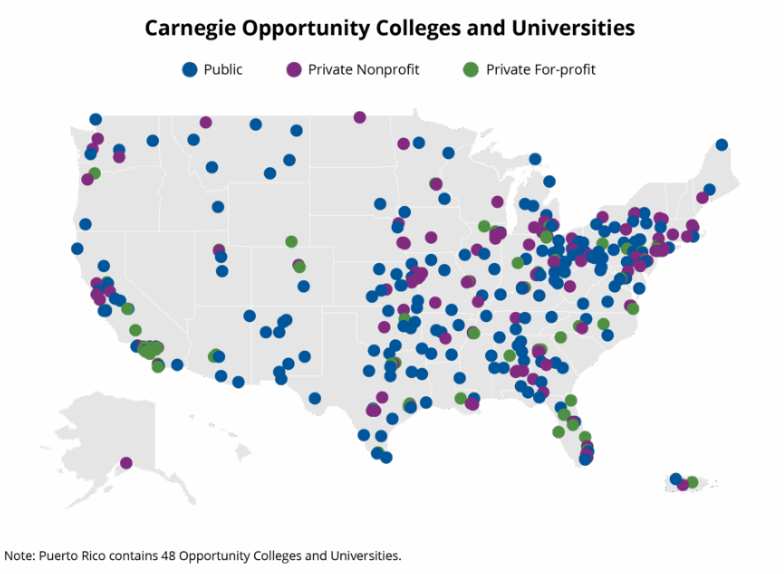
From this analysis, we identified 478 Opportunity Colleges and Universities (OCUs). These institutions span every size, type, and region, and deliver both high access and competitive earnings.
OCUs include institutions long recognized for their contributions to economic mobility — places like Arizona State University, Spelman College in Georgia, Texas A&M, and the University of Illinois Chicago. They also include institutions that receive little fanfare — places like Tohono O’odham Community College in Arizona, University of West Alabama, Columbia Greene Community College in New York, California State University — Stanislaus, College of St. Mary in Nebraska, and Santa Fe College in Florida. These are the engines of the American Dream.
The goal of recognizing OCUs is not simply to celebrate them, but to learn from the broad range of institutions delivering exceptional results. The new classification is also a call to action, an invitation to institutions across the nation to align decision- making, investment, and effort to improve outcomes for students of all backgrounds. In essence, with the OCU designation, the Carnegie Classifications — long viewed as the nation’s gold standard for organizing the postsecondary sector — can now be used to identify institutional excellence based not on prestige, student selectivity, or degrees awarded, but on how well schools set their students up for success in the real world.
In doing so, we hope to make clear that student outcomes must be the defining measure of American higher education.
How institutions can support student success
Any higher education institution can become an OCU if leaders, faculty, and staff commit to making student success their central focus.
There is no universal blueprint for becoming an OCU. In practice, institutions expand opportunity through a broad range of practices and investments tailored to their students, communities, and missions.
Take California State University – Stanislaus, as an example. Students who attend Stan State are supported by an academic community intentionally developed to feel like family. When financial challenges or personal responsibilities could interrupt their trajectories, the university’s Warrior Re-Engagement Center reaches out directly. Most students credit that outreach as the reason they return, often within one to two semesters.
Stan State’s commitment to opportunity also extends off campus. Biology students are making zero waste an achievable goal for the agriculture industry. Business students are getting real-world experience helping community members maximize their tax benefits. A new task force will bring together mayors, vice mayors, and faculty to discuss workforce needs twice annually across the six counties the university serves.
Through these partnerships, Stan State integrates work and learning, leveraging academic programming to build skills students need to thrive, not only in class, but in their future careers.
The University of Illinois Chicago is another OCU with an approach to advising that is worth amplifying: Every incoming student is assessed on their college readiness, and insights into their potential challenges and strengths inform their advising profile. From day one, students at UIC get personalized and proactive support, helping to keep minor setbacks from becoming the reason they fall behind or drop out.
UIC also invests in pre-matriculation programs to help strengthen students’ sense of belonging and set academic expectations before the semester begins. For students who are at risk of losing financial aid due to credit shortfalls, UIC provides scholarships for summer courses to help those students stay on track.
At UIC, it is not enough to get students “to and through” college — the goal is to get them “to and through and placed” onto the path to longterm progress.
A common theme appears: Becoming an OCU begins with making access and success — from application and enrollment through graduation and job placement — the heart of institutional decision-making. And OCUs hold themselves accountable for results, consistently examining what is making a measurable difference in the lives of their students.
Perhaps most importantly, being an OCU reflects a particular mindset.
It calls for rejecting the conventional wisdom that institutions must choose to either serve elite students and achieve high outcomes or provide broad access and accept modest results.
Redefining higher education’s social contract
Opportunity Colleges and Universities are aligning outreach and enrollment strategy, advising, financial aid, academic programming, and workforce preparation to help ensure higher education becomes an even more vital engine of economic mobility — particularly for students furthest from opportunity.
The good news is there is no limit to how many colleges can earn the designation; the call to become an OCU is an open invitation. Today, there are 478. Looking forward, there should be thousands.
As more institutions accept the invitation in the years ahead, and as the postsecondary sector holds itself accountable for student success, we will create more opportunity for all Americans and rebound public confidence.
That is a future worth investing in — and one all of us can rally behind.
Timothy F.C. Knowles is president of the Carnegie Foundation for the Advancement of Teaching and Ted Mitchell is president of the American Council on Education (ACE).